|
|
 At a “Industry & Education Forum Moderated by Jeff Curto” (including a continental breakfast) on the morning of March 8 at the 2014 Society for Photographic Education in Baltimore, I spoke briefly with the Kodak rep in attendance about the “Kodak Lesson Plans” then buried deeply at the Kodak site. If Kodak had a genuine interest in photo education, I asked, why were these lesson plans — roughly 200 of them, created by actual teachers for use by other teachers — not foregrounded at the website’s Tips and Projects Center, from which they were inaccessible at that time? At a “Industry & Education Forum Moderated by Jeff Curto” (including a continental breakfast) on the morning of March 8 at the 2014 Society for Photographic Education in Baltimore, I spoke briefly with the Kodak rep in attendance about the “Kodak Lesson Plans” then buried deeply at the Kodak site. If Kodak had a genuine interest in photo education, I asked, why were these lesson plans — roughly 200 of them, created by actual teachers for use by other teachers — not foregrounded at the website’s Tips and Projects Center, from which they were inaccessible at that time?
Well, he answered, first of all they were outdated — solicited from and contributed by educators in the mid-’90s, when Kodak constructed its first company website. Second, many of them involve analog cameras, papers, film, and chemistry, whereas Kodak now emphasizes digital. They were almost 20 years old; why would teachers want access to them?
Because many teachers still use analog materials, I answered. And many of these plans are adaptable to digital tools. Beyond that, they have historical value, as evidence of ways that teachers from preK-12 through post-secondary and special education worked with photography during the transition period from analog to digital. Finally, I said, teachers, not corporate executives, should decide on the continuing usefulness of this material.
He took my card, promising to look into the matter. Not given to holding my breath, I decided to make the Kodak Lesson Plans more accessible by publicizing them here at The New Eyes Project.
•
 At its site, Kodak had organized these plans by subject and grade level. Subjects included Art, Career Education, Community Studies, English, History, Languages, Language Arts, Mathematics, Music, Photography, Science, and Social Studies. Grade levels: Pre-K, Kindergarten, Elementary, Junior High School, High School, Higher Education, and Special Education. These were online as web pages, but you could easily download them and save them as individual PDF files. At its site, Kodak had organized these plans by subject and grade level. Subjects included Art, Career Education, Community Studies, English, History, Languages, Language Arts, Mathematics, Music, Photography, Science, and Social Studies. Grade levels: Pre-K, Kindergarten, Elementary, Junior High School, High School, Higher Education, and Special Education. These were online as web pages, but you could easily download them and save them as individual PDF files.
The offerings also included two “Teaching Guides,” KODAK Self-Teaching Guide to Using an Adjustable 35 mm Camera and KODAK Self-Teaching Guide to Picture-Taking — modernized versions of their perennial How to Take Better Pictures manuals. They have these online as downloadable PDF files.
Knowing that this useful material could vanish in a trice during a website makeover, we archived all of it in case it goes offline. Meanwhile, however, we’ve simply replicated their menu at a New Eyes Resources page. We’ve also taken the trouble to create downloadable PDF course packs of the lesson plans, organized under the headings Kodak has used.
We encourage you to browse this rich assortment of ideas from your colleagues in education at all grade levels. Don’t just look at those for your subject area and/or grade level; you may find something you could repurpose anywhere in this collection.
I have no idea as to how and when this Kodak Lesson Plans project originated (the plans and manuals are all undated), nor when and why it ended. I suspect that sleeps somewhere in cold storage, part of Kodak’s pre-bankruptcy paper trail. If anyone reading this took part in the program, either from the Kodak end or as a contributor of a plan, please fill in the blanks.
We welcome your comments on this material.
— A. D. Coleman
BY A. D. COLEMAN
 Making a potato-chip can pinhole camera, 1 PreK-12 teachers of photography often face the problem of the cost of equipment and supplies. That has become increasingly true during this recession, with funding for arts education often the first item to get the ax during cost-cutting frenzies.
Fortunately, you can still do a lot of photography on an extremely modest budget. Enabling your students to create their own paper cameras works as a magical introduction to the medium’s history and basic operations, but you can introduce it at any point in the curriculum.
I got interested in this pedagogically as a result of hearing Joann Brennan introduce Abelardo Morell as the keynote speaker for the 2011 Society for Photographic Education (SPE) National Conference in Atlanta this past March. A former student of Morell’s, she recalled her first Photo 101 class with Morell, in which the makings for a simple tube camera obscura sat on each student’s desk when they entered the classroom. According to Brennan, Morell assembled his tube camera casually while introducing the subject, and within half an hour they had all put together their own and looked around the room through them, enthralled by the phenomenon. So it works with students at all grade levels, including post-secondary; but the low cost and ease (and fun) of creation makes it particularly useful for faculty with younger students.
 Making a potato-chip can pinhole camera, 2 When I queried him about it, Morell told me that he’d forgotten this assignment and couldn’t reconstruct it. He didn’t originate the idea, of course. Online searching brought up a slew of how-to instructions and lesson plans. If you find something better than what I’ve gathered here, let me know and I’ll consider adding it to this selection:
- Here’s a template for making a “Tube Camera Obscura.” It comes from Willett and Patteson’s Camera Obscura site, which also includes DIY instructions on making a cheap room camera obscura.
- You can have students roll their own tube out of something like black construction paper. You can recycle just about any kind of cardboard tube that you can cut through easily — toilet-paper, paper-towel, and gift-wrap tubes, for example. Or, getting fancier, you can recycle the cylindrical cans in which numerous brands of cookies and pre-formed snack chips are sold. (Note: The New Eyes Project does not endorse consumption of junk foods.) Here, from the Exploratorium in San Francisco, are instructions on making a Potato Chip Can Pinhole Camera. And here’s a video of that approach, from YouTube. (You’ll find multiple demo videos at YouTube.)
- Because those cans are more durable, you can cut film or photo paper to fit them and use them as full-fledged cameras. Here’s one set of instructions for that process, and here’s another.
- This slideshow by Gregg Favalora demonstrates the making of a “Soda-box camera obscura with lens.”
- After this, you can move on to making a more elaborate box camera obscura with lens.
You can then progress to the crafting of a paper/cardboard camera that uses roll film.
-
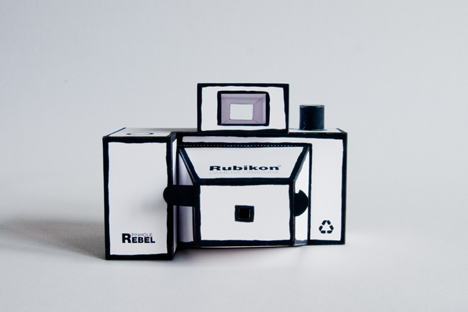 Rubikon 2 paper camera Here’s a set of instructions from Jaroslav Juřica for creating what he calls the Rubikon 2, an almost cost-free paper pinhole camera that will take 35mm film. Via Creative Commons, it comes as a PDF manual (in Czech, English, Spanish, or Portuguese) that includes a template you can print out and use to make as many of these as you need for your class.
-
 Dirkon paper camera Juřica, who’s Czech, intends this as an improvement on the Dirkon, a design for an earlier 35mm paper camera created by Martin Pilný, Mirek Kolář, and Richard Vyškovský, and published in 1979 (still the period of Czechoslovakia’s occupation by the U.S.S.R.) in the Czech magazine ABC mladých techniků a přírodovědců [An ABC of Young Technicians and Natural Scientists]. You’ll find instructions and a template of the Dirkon at David Balihar’s site, Pinhole.cz.
- Here’s a link to a set of instructions from 1885 on how to make a variety of cameras obscurae, courtesy of Jack and Beverly Wilgus’s site, The Magic Mirror of Life: an appreciation of the Camera Obscura
- “Learning About Light,” a set of camera obscura templates, instructions, and lesson plans from Juliana Lim, Mark Rau, and Ruchi Sanghvi.
- Finally, here are the outlines of half-day, one-day, three-day, and five-day “Camera Obscura & Pinhole Photography Workshops” (for grades 4-12) from Andrzej Maciejewski, who travels around Canada with his Mobile Camera Obscura offering such tutorials as a freelance teacher. You can adapt these to your own teaching situation.
 Dirkon paper camera A fringe benefit of this assignment: Depending on the level of your students, and your sense of what they can absorb, you get to go way back into the prehistory of photography and the origins of visual culture. You can bring in the awareness of the camera obscura principle among the ancient Chinese (Mo Ti), the ancient Arabs (Alhazen), the ancient Greeks (Euclid). You can discuss Talbot’s frustration with it and its successor, the camera lucida, as drawing devices, and how that led to his invention of the calotype. You can introduce basic principles of optics. (Why is the image upside down?) You can take your students from the activity of visually observing the camera obscura image to recording it on film or paper. You can stay lensless, or add lenses. You can use this for a single lesson, or build a semester’s curriculum with it.
Meanwhile, you’re demonstrating by example that you don’t need an expensive camera, or even an inexpensive store-bought one, to observe the world and make photographs.
[Postscript: You might consider tying this in to Worldwide Pinhole Photography Day, held each year on the last Sunday in April. You and your students can upload results to this site, where they will become part of the site’s permanent gallery. They have extensive shows up now for every year since 2001.]
•
A. D. Coleman is the publisher and editor of The New Eyes Project and Teaching Photography. For more information, click here.
BY ALLISON CARROLL
[Editor’s note: This report first appeared in 2009 at our companion site, Teaching Photography, in its first incarnation as Teachingphoto.com. Because that site devotes itself primarily to post-secondary photo education, we’ve replicated it here. — A. D. Coleman]
 Allison Carroll I was two years out of the Art Institute of Boston, studying photography. I had four years under my belt of gainful employment as a studio manager for a fine-art photographer, and three summers of teaching photography to pre-college high school kids. I thought this made me fairly well equipped when I signed a contract to become a part-time faculty member of the Art Department at St. Sebastian’s School in Needham, MA.
Luckily for me, the headmaster shared my opinion. To be truthful, the knowledge department did not concern me. I had always been one of the most technically skilled students in my photo classes, and I know my art history well. I can even go on and on about how Abe Morrell makes his camera obscura pictures. The challenge, however, and what I feared the most, was the actual act of teaching—in particular, teaching at a private, all-male Catholic high school.
 Daniel Halloran, “After Arno” Teaching at an all-male school comes with its very own set of challenges. Most of my students are driven, goal-oriented, and focused. They are polite, being bound by an Honor Code within the walls of the school. They are also outspoken, opinionated, and more often than not, they act like the teenage boys they are. My goal was to get them to realize that photography is actually a very interesting and important subject—and, frankly, to get them to take me seriously.
Did I mention that when I started, I was twenty-four years old? And no one would mistake me for Kobe Bryant. Most of my students tower over me. I’ve taken to wearing two-inch high heels just to come close. At the first meet-and-greet with the parents, I was asked more than once if I was a sister of one of the students. This was a huge hurdle to overcome. Teenage boys are not used to seeing young women as authority figures.
 “Highway,” © Jack McAvoy I’ve learned many things along the way, and I’d like to share them here in the hopes that other young teachers can glean something from my experience. I’ve decided to concentrate on five points I think are most important.
#1 Remember High School? Yes, I know; I tried to block it out, too. But remembering what it was like to be a high school student has really helped me understand my students. I’ve been asking myself things like, what was important to me when I was 16? Or, how much time did I have to commit to my artwork when I was in 11th grade? Like many of us, I remember college fondly, and often find myself defaulting to my work habits in college, when I had the time to shoot six rolls of film a week, and spend hours in the darkroom. But in high school, you just can’t do that—and frankly, very few students will want to work that hard. So I have curbed my assignments to fit into their schedules. Quality over quantity, I suppose. I’d rather give students a bit less work, and have them complete all of it, than give them a huge assignment and only receive half back. So I cut down on work time, and make it up in creative project ideas, figuring that inspired and challenged students are more likely to work hard to accomplish their goals.
 Brian Walker, untitled #2 Respect Your Students. As a teenager, I never wanted to be underestimated. I had all these ideas, and I wanted to face the world head-on with them. It seems many teenagers feel this way—full of potential energy that, if channeled in the proper way, can have amazing results. So I try hard not to underestimate my students. If they feel I expect great things from them, they’re more likely to fulfill them—and themselves.
#3 Be Yourself. A lot of people told me at the start of my first year that I had to start out mean—to scare them into submission. “Give ‘em detention for looking at you wrong!” “Kick him out if you don’t like his tie!” This is some of the advice I was given.
 Matthew Maskell, untitled I am not a mean person by nature, so it’s actually difficult for me to even try to be mean. It’s a bit of a character flaw. Perhaps I could have been a little harder on some of my students last year, but I have learned from that—and well, I’ve decided I’m still going to be nice. Students see right through dishonest teachers—and they will return the favor in spades. If you are tough person, then you should be a tough teacher; and if you aren’t tough, then you shouldn’t try to be. I discovered I can be myself, and the students really respond; in fact, it allows them to be themselves, and creates a much safer atmosphere for them to make their art in.
 Jack McAvoy, “Light” #4 Don’t Them Get Away With Stuff. Often, students of this age are looking for the limits of things. They want to know how far they can get before they are reeled back in. It’s the old “give them an inch and they’ll take a mile.” In my first year teaching, I was too lax. This year, my main goal has been to make the rules and assignments very clear, and to adhere to them strictly. They must be in proper dress code all the time. They must bring in the assigned work on time or they will receive a late mark. They will not use words or expressions I have banned from class. And they will get sent to the office if these rules are broken. This has really helped and improved behavior markedly. Show weakness and things will spiral out of control; uphold the rules and limits will be observed.
 Michael Ewing, untitled #5 Be Present and Reliable.High school students are overcommitted; they have a lot going on. There are extracurricular activities, outside music lessons, sports, jobs, and on and on. They also may need extra help in school or extra time to finish work. My students are always very appreciative when I can stay after, to let them work in the darkroom, or when I do small things, like bring in books they are interested in looking at. If you can show them that they are important to you, and that you can be around for them, they feel appreciated and they want to work for you. I’ve also found that the students really want to rely on you as their teacher. They seem almost offended on days when I have to miss school. They depend on me to be there when I say I’ll be there, to return a test when I say I’ll return a test, and label their work with their names when I hang it up. I have worked very hard this year to me more reliable.
 Daniel Halloran, “Mazie” #6 The Best Teaching Advice That Anyone Ever Told Me. It was to never, ever forget that you are the adult with a college degree (sometimes 2), and they are the teenagers. They are teenagers, who often know almost nothing on your subject when they enter the classroom. If you can harness this confidence in yourself, and display it to your students, you will more than likely succeed.
Finally, after my second year teaching at St. Sebastian’s, we are all about ready to go on vacation. Maybe next year I’ll have a new set of rules.
•
Above you see some examples of work by my students. Here’s some by me:
 Allison Carroll, “Tent, Martha’s Vineyard,” 2008 •
 Allison Carroll, “Places of Potential Series”  Allison Carroll, “Places of Potential Series” •
Allison Carroll graduated in 2005 from the Art Institute of Boston at Lesley University with a BFA in photography. She currently works as a fine-art photography studio manager and as a teacher at St. Sebastian’s School. She enjoys live music in dark bars and taking pictures of grass, rocks, and water. To contact Allison by email, click here. To see more of her work visit her blog at www.smallsquarepictures.blogspot.com.
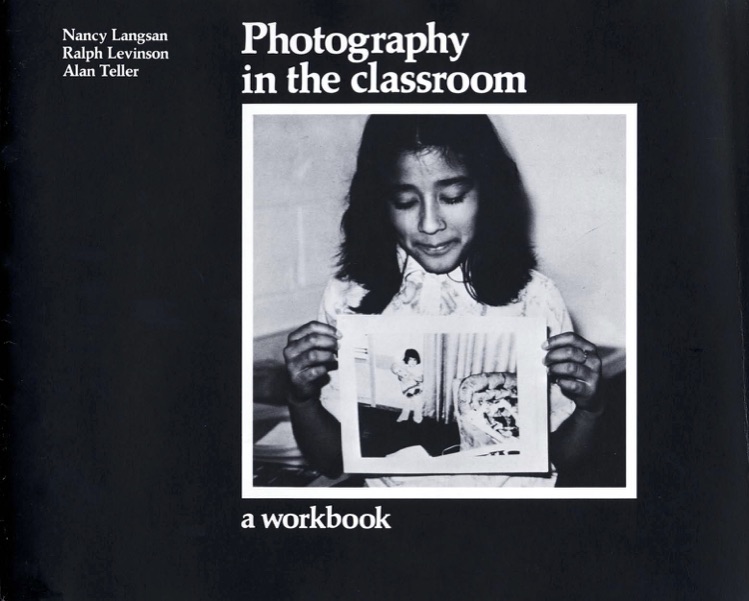 Langsan, Levinson, Teller, Photography in the Classroom (1975), cover •
Photography in the Classroom: A Workbook (1975)
by Alan Teller, Nancy Langsan, and Ralph Levinson
This workbook from 1975 represents one of the types of preK-12 photo-ed programs that emerged in the late 1960s-early ’70s in the U.S. and elsewhere. Based on an Artists-in-Schools grant from the Illinois Arts Council, it took place in two elementary schools and one junior high school. The workbook contains a wealth of information on all aspects of designing, planning, actualizing, and reviewing such a project. We republish it here with the kind permission of Alan Teller.
•
Click on the links below for PDF files of the complete book or sections thereof.

Photography in the Classroom (1975). Complete – 6mb.
In sections:
From Looking at Photographs: Animals (1995)
by A. D. Coleman
 A. D. Coleman, “Looking at Photographs: Animals” (1995), cover Now long out of print, this book, created for young people ages 8-12, serves as a primer on how to read photographs. Here we present sample chapters that use public-domain images as reference points.
Click on the links below for PDF files of the chapters.
About This Book
(This previously unpublished author’s note appears here for the first time.)
This book came about as a collaboration with the late Jacques Lowe, a photographer and book packager. Having produced a series of children’s books under the rubric Looking at Paintings, Jacques turned his attention to a comparable project about photography. He asked me to provide the texts; I was both honored and excited by the assignment: How do you teach young people to read photographs, and give them a vocabulary with which to discuss those images? How do you take complex ideas about photographic seeing and make them available to kids ages 8-12?
The larger plan included four titles: Animals, People, Places, and Things. Our intent was to find a selection of images for each volume that would permit me to discuss many of the issues particular to photography, from its technical aspects to the public and private meanings that photographs carry, including how photographers work and think. The images in the Animals book came from such photographers as James Balog, Peter Beard, David Doubillet, Elliott Erwitt, Ralph Gibson, Mary Ellen Mark, Sylvia Plachy, William Wegman, and Garry Winogrand.
The publisher that Jacques found, Chronicle Books in San Francisco, accepted the project enthusiastically. They committed to publishing the first two volumes, Animals and People, and then following those with the second set if the first pair did well. For reasons too complicated to explain, I wrote the texts for Animals and shared the picture-editing duties with Jacques, while he did most of the picture selection for People and wrote its texts himself (though the book includes my Preface as it appears in the Animals book, and here). These two titles appeared simultaneously in Spring 1995.
Dissatisfied with the results from those first two volumes, despite reasonable sales and glowing reviews, Chronicle remaindered both books just a year after publication, and cancelled the remaining two. This disappointed both Jacques and myself deeply, but he found no way to take the project elsewhere before his death. Rights to the overall project now rest with his estate.
I have considered ways of reworking the idea, and have come up with some; should anyone know a publisher interested in pursuing that, please contact me. (Review extracts appear at The Nearby Café.) Meanwhile, copies of the Animals book (of both books, in fact) can be obtained reasonably inexpensively and easily through various online booksellers. So any teacher interested in trying this out with students should have no difficulty finding one.
I’ve decided to post three sample texts — on Eadweard Muybridge, Jacques-Henri Lartigue, and Alfred Stieglitz — with their accompanying images, plus the book’s Preface and its Glossary. This provides a look at the approach we took, and may help anyone engaged in a similar effort.
— A. D. Coleman, Staten Island, NY, March 2006
|
 Visit Our Sponsor Visit Our Sponsor Copyright Notice All content of this publication is © copyright 2004-2014 by A. D. Coleman and the authors unless otherwise noted. All materials contained on this site are protected by United States copyright law and may not be reproduced for commercial purposes without prior written permission. All photos copyright by the individual photographers. "Fair use" allows quotation of excerpts of textual material from this site for educational and other noncommercial purposes.
Published by Flying Dragon LLC.

|